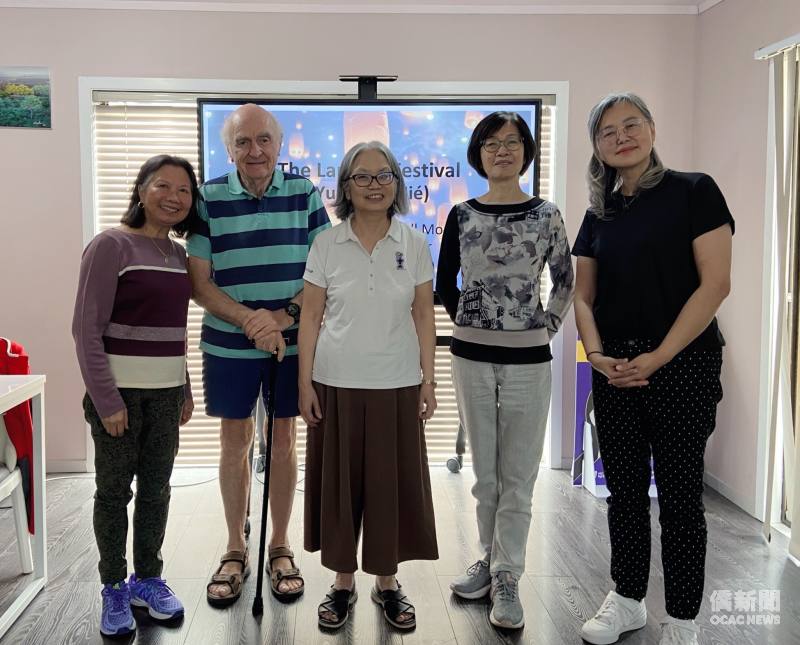
 Learning the story of the Lantern Festival alongside Mandarin (Teacher Eva: far right; Rachel: second from right).
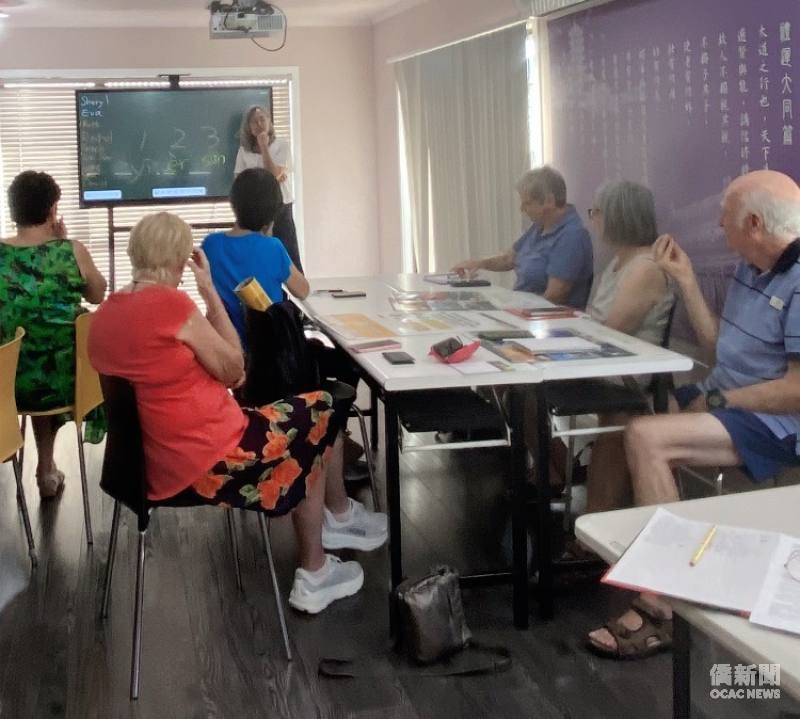 Making the most of every learning opportunity in class (Rachel: wearing dark blue)
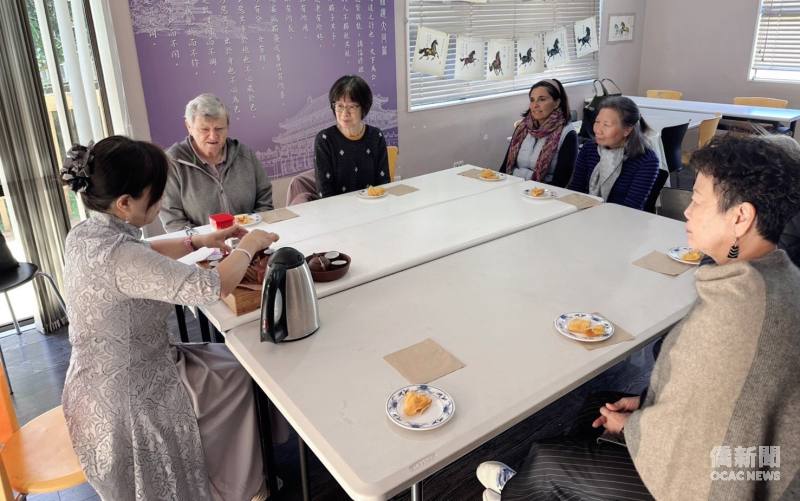 Experiencing Taiwanese tea culture in class (Rachel: third from left).
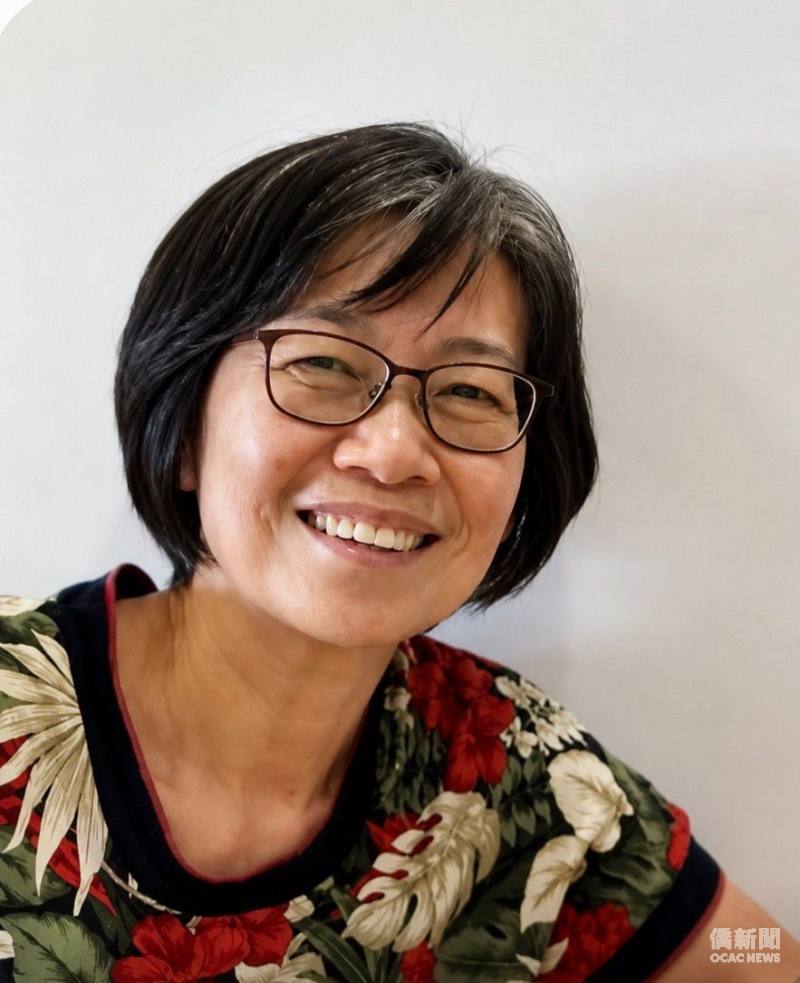 “Just go for it. Everyone is in the same boat!”Rachel said
More than fifty years ago, a primary school teacher gave Rachel a sentence that stayed with her for life.
Rachel was a mischievous Primary Three student in Malaysia when she confidently told her Mandarin teacher that learning Mandarin was useless because “English is the top language in the world.”
Her teacher’s response was equally direct.
“One day you will be ashamed because you are ethnically Chinese and you cannot speak it.”
At the time, Rachel did not think much of the comment. Yet decades later, she still remembers those words.
Today, she is finally taking up the challenge.
Rachel grew up in Malaysia speaking Hokkien with her parents and English with her siblings. Her exposure to Mandarin at school was limited, and after university in New Zealand, English became the main language of her everyday life.
When she later returned to Malaysia after graduation, she realised that she spoke very little Hokkien, although she picked up Cantonese from colleagues. Mandarin, meanwhile, remained a language she had never become comfortable speaking.
Life continued, and the childhood challenge was left unfinished.
Then everyday experiences began to remind Rachel of the language she could not speak.
She noticed that older Asian women would sometimes approach her in Asian shops and ask for help reading labels on food packaging or understanding something they had seen. At one stage, this happened almost every week.
Rachel wanted to help, but often could not understand what they were asking.
“I thought it is time to learn.”
That simple realisation eventually brought her to the Taiwan Center for Mandarin Learning (TCML) in Auckland.
Her original goal was straightforward: she wanted to learn Mandarin so that she could communicate more confidently with people around her. But joining TCML has gradually introduced another dimension to her learning—the culture behind the language.
Rather than treating Mandarin as something that exists only in a textbook, TCML connects language learning with cultural experiences. Rachel has had opportunities to learn about Chinese traditions preserved in Taiwan and participate in activities that introduce students to aspects of Chinese cultural heritage which only exist in Taiwan.
One experience that particularly stood out was the Taiwanese tea activity. Through the tea experience, Rachel was able to encounter tea not simply as a drink, but as part of a cultural tradition involving hospitality, manners, appreciation and a sense of calm.
For Rachel, experiences such as this provide another way of understanding Taiwan. Language gives her words, while cultural activities help give those words a context.
This has also changed the way she looks at cultural experiences in Auckland. Before beginning her TCML journey, she had encountered Asian cultural celebrations and traditions without necessarily understanding the meaning behind them. Now, as she learns Mandarin and explores Taiwanese culture, she is becoming more curious about the stories, customs and traditions connected with the language.
Her learning is still very much a work in progress.
The four Mandarin tones remain one of her biggest challenges. Sometimes she uses the wrong tone and discovers that the listener cannot understand which word she is trying to say.
“I understand more than I can speak.”
Constructing complete sentences has also required patience and practice. But Rachel is beginning to see Mandarin differently. It is no longer simply the difficult language she encountered briefly as a child. It has become something she has actively chosen to pursue.
Learning at TCML has also given her the opportunity to learn alongside other students. The classroom provides a supportive environment where learners can practise, make mistakes and try again without feeling that they have to be perfect.
For Rachel, this matters because her ultimate goal is not simply to complete a course. She wants to use Mandarin in real life.
She hopes to read a Mandarin newspaper, write Chinese characters, and converse more comfortably with friends who were born in China. She would also like to visit places where she can put her Mandarin into practice.
At the same time, her experience at TCML has encouraged her to learn more about Taiwan itself. Through the combination of language lessons and cultural experiences, Taiwan is becoming more than simply a place associated with a language she wants to learn.
It is becoming a culture she wants to understand.
There is something fitting about this journey.
More than fifty years ago, Rachel told her teacher that Mandarin was unnecessary because English was the most important language in the world. Today, she is discovering that knowing another language can create connections that English alone cannot always provide.
She is not learning Mandarin because a teacher told her she should.
She is learning because, later in life, she has found her own reasons.
Her message to anyone who has been thinking about learning Mandarin but feels too old, too nervous or simply unsure where to begin is simple:
“Just go for it. Everyone is in the same boat! You will be surprised to see how well you progress.”
Rachel still has a long way to go. She is still practising tones, building sentences and finding the courage to speak.
But the most important part of her journey has already happened.
She has begun.
And along the way, a childhood challenge has become something much more meaningful—not only an opportunity to learn Mandarin, but also a chance to rediscover culture, understand Taiwan from a new perspective, and build connections through language.
Perhaps, after all these years, that primary school teacher was right about one thing: Rachel would remember the lesson.
She just found her own way to answer it.
更多僑務新聞請至
僑新聞