Taipei, March 3 (CNA) Taiwan is awaiting official notification from the United States regarding the status of the Agreement on Reciprocal Trade (ART) after the U.S. Supreme Court ruled President Donald Trump's "reciprocal" tariffs unconstitutional.
Speaking to reporters before a legislative hearing Tuesday, Premier Cho Jung-tai (卓榮泰) said Taiwan's negotiation team remains focused on ensuring that the bilateral trade deal remains intact despite the legal challenge to Trump's global tariff policy.
"The U.S. has pledged to notify its trade partners once the subsequent administrative and legal processes are finalized, and that certainly includes Taiwan," Cho said when asked about opposition doubts that the ART was still valid.
"This is the most current update we have."
The ART, signed in mid-February, established a 15 percent tariff on Taiwanese goods and included provisions exempting 1,735 categories of goods from "reciprocal" duties.
Combined with another 337 categories of goods exempted for all U.S. trading partners under an executive order, the exemptions would bring the average effective tariff on Taiwan's exports under the Trump tariff policy down to 12.33 percent, according to official estimates.
The agreement was originally slated for submission to the Legislative Yuan for deliberation alongside the MOU, which was signed in mid-January.
The legal landscape shifted when the U.S. Supreme Court found that the Trump administration's use of the International Emergency Economic Powers Act (IEEPA) of 1977 to impose its "reciprocal" tariffs exceeded executive authority, rendering them invalid.
In a swift countermove, Trump signed a proclamation invoking Section 122 of the Trade Act of 1974 to impose a global 15 percent tariff based on balance-of-payments authority.
As of early March, however, the U.S. government had only imposed a 10 percent tariff on global imports under Section 122, lower than the average effective tariff of 12.33 percent Taiwan secured under the ART.
Vice Premier Cheng Li-chiun (鄭麗君) reassured the public in late February that the Supreme Court's decision would not undermine the core benefits Taiwan secured under the ART.
Beyond the benefits of the ART, she said at the time that provisions within the investment MOU continue to provide Taiwan with preferential treatment regarding potential tariffs stemming from Section 232 investigations under the U.S. Trade Expansion Act.
more OCAC News, welcome to
OCACNEWS.NET.
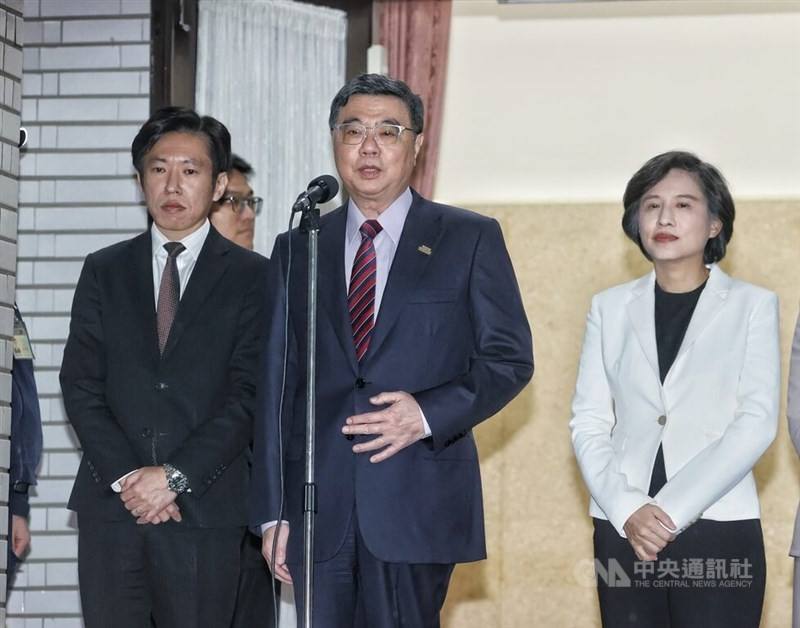 Premier Cho Jung-tai (center) speaks to reporters before a legislative hearing Tuesday, accompanied by Vice Premier Cheng Li-chiun (right). CNA photo March 3, 2026
Update Date:
2026/03/04 Back